




SAMAYA x MARTIN RIVET
SOLO CROSSING OF THE PYRENEES

Martin Rivet, an outdoor filmmaker and photographer, is no stranger to wilderness expeditions. Never alone, rarely on a break, he needed an engaging solo adventure. Returning to his roots, he tells us about his journey of over 1,000 kilometers on foot, completely self-sufficient.
“I’ve been hiking in the Pyrenees since I was a little boy, and this adventure was an opportunity to rediscover this playground in a different way, sleeping in a tent and being as self-sufficient as possible. It is a privilege to be able to free up time just for yourself, to be truly alone, and to experience thinking only with yourself. It is a great gift I gave myself, to offer myself these 40 days alone facing myself.
In addition to self-sufficiency, I set myself the challenge of filming and creating content during this crossing, which adds a significant amount of weight. A heavy pack is the primary cause of abandonment on long-distance treks. So, I started with one premise: find the lightest equipment possible. An ultra-light tent makes all the difference.”

I started from the Mediterranean Sea to reach the Atlantic Ocean by crossing the entire Pyrenees, through its mountain ranges. My route was divided into 4 stages: the Pyrénées-Orientales, Ariège, Hautes-Pyrénées, and Pyrénées-Atlantiques. In terms of topography, there are peaks between 2,000 and 3,000 meters in altitude for the highest ones.
I had a huge number of surprises throughout my journey because I didn’t follow the GR trail. I went instead to see places that interested me, avoiding the less wild supply towns, which led me to Pic Carlit, a summit reaching over 2,921 meters in altitude and the highest in the Pyrénées-Orientales.
My route took shape along the way and depended on the weather conditions. When it was bad, I tried to descend in altitude to avoid staying at 3,000 meters if a thunderstorm threatened.
The first week was very hard physically and mentally. Primarily because I was overloaded; I had adjustment and pack-fitting issues that caused me hematomas and severe pain. I also dealt with many thunderstorms and snow, notably at Pic Carlit. I had only the first few days behind me, and mentally, knowing that 30 more remained was a bit tough. The pain combined with the bad weather really made me doubt: if I couldn't fix my pack and shoe problems, I would have to make a decision. I was very lucky afterwards; the weather was beautiful.

After the very dry Pyrénées-Orientales and the Hautes-Pyrénées, I reached the Pyrénées-Atlantiques, a section I had already explored a lot before. So, I imagined a route that would allow me to rediscover my region and visit places I didn’t know yet.
It was mid-September, a period that isn't the best for crossing the Pyrenees, with all the shelters closed and the weather being temperamental. Setting off at this time is something I enjoyed because it is much less frequented than in summer. In Andorra and Ariège especially, I spent entire days without crossing paths with anyone. I was truly left to my own devices and I thought it was great.
I really appreciate solitude. I think when it is sought and voluntary, it is a very pleasant feeling. Besides, walking is a very meditative activity that leaves time to truly think, to take a step back on many things.
I still managed to meet people during these 40 days and I had some beautiful surprises. In the mountains, there is a kind of hospitality that you don't find anywhere else, a mutual aid that I find truly wonderful. Sometimes, the weather was very complicated and I would take refuge in a mountain hut. Others would arrive and we would end up in this little cocoon packed to the brim, with so much to eat that we shared everything: local products, cheese, everything needed to spend a lovely evening. These are brief meetings, ephemeral moments, but they are heartwarming. I think it helped from a mental point of view; it boosted me during slightly more solitary moments.

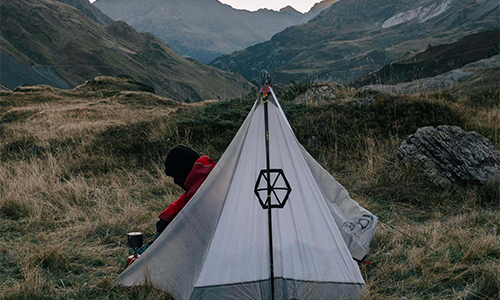
The experience of bivouacking for 40 days like that is enormous. The fact of choosing your location, of being free, is what I love. I set myself daily stages and bivouac spots for the evening, close to water points and fairly low down.
Except in national parks where it is more regulated, I loved this freedom of being able to choose my small comfort for the night and my spot to bivouac. There is a really super pleasant feeling in the evening when you have just finished walking, setting up camp, pitching your tent, cooking your hot meal, and getting into bed—tired but happy about the day that has just ended. Sleeping in a tent is like a ritual that establishes itself every day. It’s like feeling at home with new routines. It’s the only moment that allows you to recover to be able to leave again the next day.
I left at a time when there is a huge amount of deer rutting. One day in Ariège, I arrived in a Spanish area where I set up my bivouac. During the night, they were extremely close. It was a full moon night, and when I opened the tent door, I watched them barely ten meters away from me. It was impressive, almost unreal. Impossible to sleep!

What is funny with trekking, and also a bit depressing at the same time, is that at each mountain pass you cross, you see the peaks you have just covered, but also all those that await you. These mixed feelings were particularly poignant during the crossing of Ariège. I saw endless mountains and I never thought I would get out of it. When I arrived at the end, I caught a glimpse of the Pic du Midi: I was a little bit more at home.
It was a truly particular sensation, like when I saw the ocean.
It was over.
There was nothing left to cross, nothing left on the horizon.”
©Photographs by Baptiste Cibat @baptistecibat